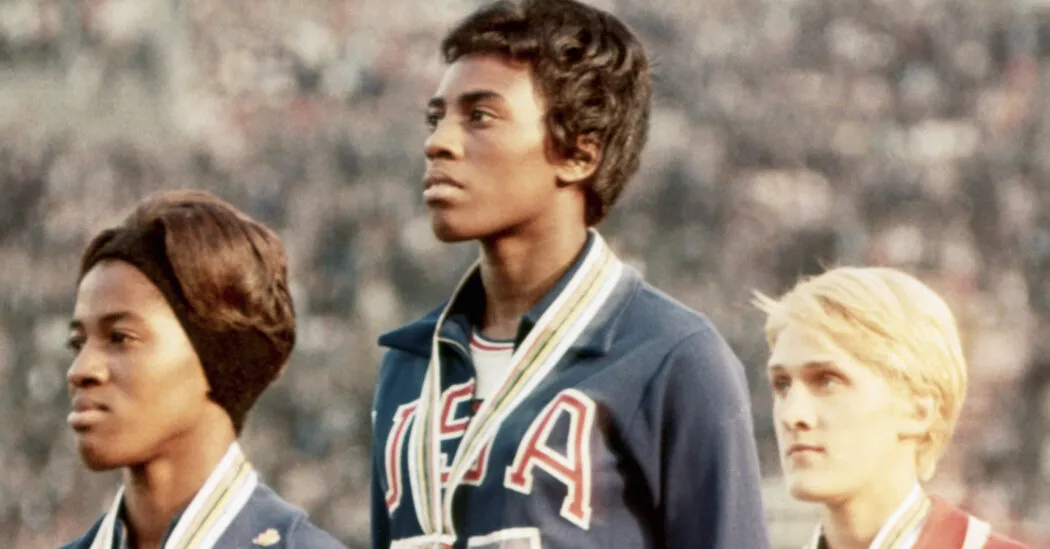
To stay loose for the women’s 100-meter sprint at the 1968 Olympics in Mexico City, Wyomia Tyus danced the “Tighten Up” before settling into her starting blocks. The dance song was an early funk classic by Archie Bell and the Drells, a Houston band that proclaimed with jaunty assurance, “We don’t only sing, but we dance just as good as we want.”
Tyus stepped with similar confidence into the blocks. And 11.08 seconds later, she ran into history. She set a world record and became the first man or woman to win 100-meter titles in consecutive Olympics, ratifying the gold medal she won unexpectedly as a 19-year-old at the 1964 Summer Games in Tokyo.
Tyus’s brief dance was preserved on video and became part of Olympic lore. But, she acknowledged, perhaps no one noticed the protest against racism symbolized by the shorts she wore as a Black woman from Jim Crow Georgia. The shorts were dark blue — as close to black as Tyus had available and distinct from the official white shorts that her two American teammates wore in the race.
“It made the statement that I needed,” Tyus, now 75, said in a pair of expansive telephone interviews, calling it “my contribution to the protest for human rights.”
Antiracism protests by the quarterback Colin Kaepernick, and all the athletes who have denounced the murder of George Floyd, had an iconic precedent in the indelible glove-fisted salute by the sprinters Tommie Smith and John Carlos during the playing of “The Star-Spangled Banner” at the Mexico City Olympics.
But female athletes of color also have long advocated social justice, often to be overlooked. Only recently has Tyus finally begun to be recognized for her activism as well as her sprinting.
The stories of Tyus and other unnoticed or forgotten Black female athletes help provide an evolving understanding of sporting activism. Smith and Carlos, as powerful and unforgettable as their protest was, are “not where the story begins or ends; it’s more expansive than that,” said Amira Rose Davis, an assistant professor of history and African American studies at Penn State who is writing a book to be called “Can’t Eat a Medal: The Lives and Labors of Black Women Athletes in the Age of Jim Crow.”
Tyus does not remember the moment she decided to wear the dark shorts. She did not tell anyone of her intention, she said, or speak to reporters about her gesture afterward, believing that few seemed interested in what a woman, especially a Black woman, had to say in that era. “I wasn’t doing it for the press,” she said. “I was doing it for what I believed in, that it was time for a change.”
As the Mexico City Olympics continued, Tyus publicly criticized the expulsion of Smith and Carlos from the Games. She wore the dark blue shorts again in anchoring the American women to a world record in the 4×100-meter relay, then joined a teammate in briefly clenching her fist on the medal podium in support of Smith and Carlos. She also emphasized to reporters that the members of the relay team were dedicating their gold medals to their ousted countrymen.
Several years ago, Tyus donated her shorts to the National Museum of African American History and Culture in Washington. Yet they remain cataloged online simply as an article of athletic clothing, not an emblem of protest: Wilson track shorts, royal blue, elastic waistband and leg openings, wash in lukewarm water, use mild soap, do not bleach.
Not until Tyus co-wrote her memoir, “Tigerbelle,” in 2018, did other athletes, reporters and the public begin to understand her activism. Davis, of Penn State, places Tyus at a pivotal point where Black female athletes began decrying gender-based discrimination as well as racial injustice.
Tyus became a vital force in the formation in 1974 of the Women’s Sports Foundation, which is dedicated to enabling opportunities for girls and women. (“Without Black athletes, we would have been nothing,” said Donna de Varona, the foundation’s first president.) Her activism also was a forerunner to the Black Lives Matter protests by players in the W.N.B.A. and to the advocacy of the American hammer thrower Gwen Berry, who bowed her head and raised her fist after winning her competition at the 2019 Pan American Games.
“I feel there is a direct connection between us,” Berry said of Tyus. “It’s unfortunate we don’t hear these stories. So often, women are overlooked. We bear the biggest burdens.”
Sleeping in a Dresser Drawer
Tyus grew up in Griffin, Ga., south of Atlanta, in the era of separate drinking fountains and separate schools for Blacks and whites. She rode an hour on a bus to her school when she could have walked to the nearby white school. The Ku Klux Klan, Tyus wrote in her memoir, was “a regular participant in local parades.”
The family lived on a dairy farm. Her father, Willie, was a tenant worker. Her mother, Marie, worked at a dry cleaner. She and her three older brothers slept in dresser drawers when they were infants. The family’s farmhouse didn’t have indoor plumbing. Drinking water was carried from a well and sometimes scooped from a hollowed-out gourd. Still, the house felt like a safe haven, Tyus recalled, with plentiful bedrooms and fireplaces, vast porches, a huge kitchen and wide-open spaces outside to roam the surrounding fields and woods.
White girls were not permitted by their parents to play with her and her brothers, Tyus said. But white boys did, and were allowed, as long as they did not use the N-word. “You do not let them call you by any names but your name,” she said that her father told her and her brothers.
On Sundays, she walked through the woods with her father. In ways that were sometimes direct but often so subtle that she would not fully understand until later, Willie Tyus used nature to speak of change and freedom. “Things are not always going to be this way,” she remembered her father saying. “Ask questions. Stand up for what you believe in. You’re going to do things in this world.”
Then, on Aug. 29, 1959, her 14th birthday, the family house caught fire and her world collapsed. The family lost everything, Tyus said, including her father’s spirit and determination. He died a year later. “The fire killed him,” she wrote. “You could see it.”
Tyus said she closed in on herself, becoming a recluse, giving mostly one-word answers when she spoke.
She began to distract herself, and then express herself, with sports, first basketball, then track. She was recruited to Tennessee State, in Nashville, to run for the university’s renowned women’s track team, the Tigerbelles. The coach was Ed Temple, who sent 40 sprinters to the Olympics from the 1950s to the 1980s. They won 13 gold medals, including three by Wilma Rudolph at the 1960 Rome Games.
A Citizen of the World
At the 1964 Tokyo Olympics, Tyus was 19 and intending to compete more for experience than for victory. Temple told her that 1968 would be her year. But she upset her friend and Tennessee State teammate Edith McGuire to win the 100, before McGuire prevailed in the 200. Another awakening occurred off the track.
There were no back-of-the-bus humiliations for Black athletes in Tokyo. No separate bathrooms. The athletes’ village seemed a kaleidoscope of different colors, nationalities, languages. World War II was not yet two decades past and Black people and other Westerners were still viewed as “kind of strange” in Tokyo, Tyus recalled. But she and McGuire marveled at how they were treated with friendly respect by the Japanese when they went shopping.
“To go to a different place and find out everybody was using the same fountains, the same bathrooms, that people are somewhat nice to you, that was eye-opening,” McGuire said.
When they returned home, Tyus and McGuire said, they were given a parade in Atlanta, but only through Black neighborhoods.
By October 1968, when the Mexico City Olympics arrived, Tyus had graduated from Tennessee State with a degree in recreation. She had become a citizen of the world through sport, having traveled to the Soviet Union and Africa. At home, social unrest was aflame over civil rights and Vietnam. In 1967, she attended a speech on campus by the charismatic civil rights leader Stokely Carmichael, who espoused Black power and, Tyus wrote, “reminded us that we were human beings, that we were no longer slaves and that we had to be more active.”
Six months before the Olympics began, Martin Luther King Jr. was assassinated in Memphis, down the interstate from Nashville. Days before the opening ceremony, dozens of Mexican students were killed in a Mexico City plaza by government snipers.
The Olympic Project for Human Rights, or O.P.H.R., organized by the sociologist Harry Edwards, advocated boycotting the Games. But Tyus said that she and other Black female athletes were barely consulted. It was assumed by the men, she said, that “if we say we’re going to do it, the women will follow.”
Edwards said he did not contact female athletes because nearly all of them were affiliated with historically Black colleges and universities, which did not support the project. But, he added in a text message, regardless of whether Tyus supported the O.P.H.R., Olympic protests and Smith and Carlos, “she is still one of the greatest athletes of her day.” He added, “And that’s enough, and should be recognized as such.”
Kareem Abdul-Jabbar, then Lew Alcindor, declined to participate in the Mexico City Olympics, but a widespread boycott did not occur. Each athlete was left to make his or her own choice about protesting. Smith and Carlos wore black gloves. Some Americans wore black socks and berets and supportive buttons. Tyus decided to wear her dark blue shorts for the 100 meters.
Her gesture was apparently not noticed or acknowledged in mainstream news accounts at the time. The New York Times’s report from Oct. 15, 1968, focused on Al Oerter, the American discus thrower who became the first athlete to win a gold medal in the same individual event in four consecutive Olympics. Tyus was quoted only as saying that these would be her final Games and that “I’d like to retire as a winner.”
The next day, Tyus returned to the Olympic Stadium to watch Smith and Carlos run the 200 meters. When she saw them wearing black socks without shoes and raising their gloved fists on the victory stand, the moment felt “mind blowing,” she said at a 2018 symposium at Penn State. She heard rumbling discontent in the stadium during the anthem and told herself, “My gosh, I hope nothing serious happens here.”
Two days later, after eating breakfast in the athletes’ village, Tyus and some track teammates were informed by an Associated Press reporter that Smith and Carlos had been barred from the Olympics. “I think it is awful,” Tyus was quoted as saying. “They did not hurt anybody. As long as they don’t touch somebody and hurt them, I don’t see how they can be punished.”
Raised Fists
For the 4×100-meter relay, Tyus again wore her dark blue shorts. So did her three teammates, but one of them, Mildrette Netter, said recently that she was unaware of any protest. At a postrace news conference, Tyus was quoted in a Reuters article as saying, “We dedicate our relay win to John Carlos and Tommie Smith.”
On the victory stand, Tyus and a teammate briefly raised their fists in support of Smith and Carlos, as seen in photographs discovered by Davis in the archives of the International Olympic Committee. Tyus identified the teammate as Barbara Ferrell, who did not respond to requests for comment.
The podium gesture was a quick show of solidarity with Smith and Carlos, Tyus said. Members of the U.S. men’s 4×400-relay team also raised their fists. The dark blue shorts made a more important statement, Tyus said, because “the shorts were at the forefront of my whole being to bring attention to human rights, whether anybody picked that up or not.”
More than 50 years later, in Tyus’s native Georgia, whether the basketball players knew her name or not, members of the Atlanta Dream W.N.B.A. team revolted against a team owner, Senator Kelly Loeffler, after she criticized the Black Lives Matter movement. In February, Loeffler, who lost her bid for re-election, sold her interest in the team. This is what Tyus had long advocated: Speak up and speak out.
“If you speak out, you do see change,” she said. “Staying silent doesn’t work.”
Susan C. Beachy and Sheelagh McNeill contributed research.
Stay connected with us on social media platform for instant update click here to join our Twitter, & Facebook
Denial of responsibility!TechAzi is an automatic aggregator around the global media. All the content are available free on Internet. We have just arranged it in one platform for educational purpose only. In each content, the hyperlink to the primary source is specified. All trademarks belong to their rightful owners, all materials to their authors. If you are the owner of the content and do not want us to publish your materials on our website, please contact us by email – [email protected]. The content will be deleted within 24 hours.