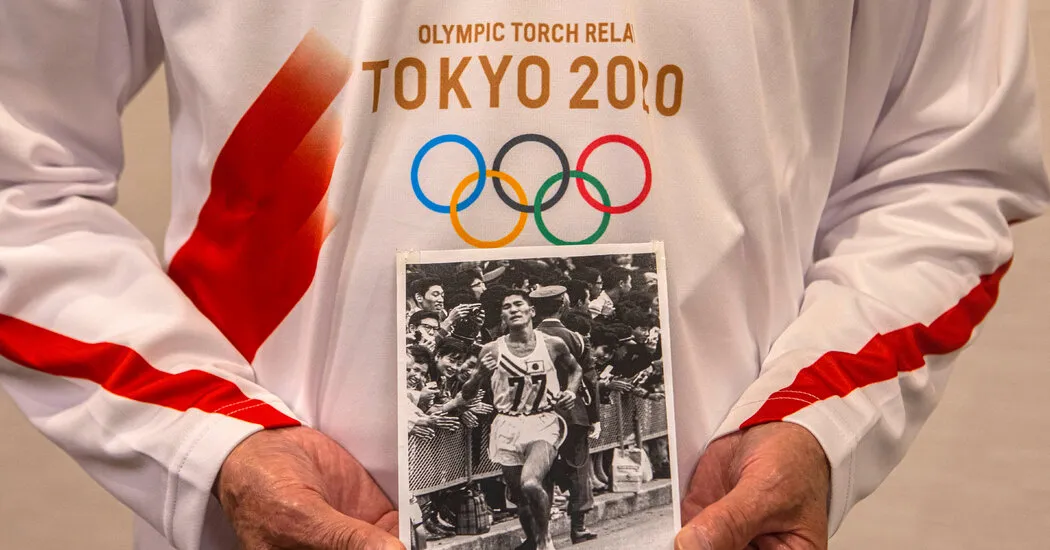
SUKAGAWA, Japan — More than 70,000 fans in the National Olympic Stadium — and millions more watching on television — roared as Kokichi Tsuburaya ran on to the track, one lap from securing a silver medal at the 1964 Tokyo Games. The Japanese had not won a medal in track and field, and now Tsuburaya was about to make history.
Abebe Bikila, the Ethiopian who captured the gold medal in Rome in 1960 while running barefoot, finished four minutes earlier, setting a world record. As Bikila did calisthenics in the infield, Tsuburaya headed to the finish line looking exhausted and pained.
The farm-boy-turned-soldier was running in just his fourth marathon, and his gutsy effort would reaffirm the widely held belief in Japan that perseverance and mental toughness can overcome deficiencies in raw talent.
A medal would also add an exclamation point to the Tokyo Games, which were being celebrated as evidence of the country’s emergence from the devastation of World War II. Tsuburaya’s success in the most grueling of races spoke to the nation’s collective sacrifice.
The celebration was premature and the events that were about to unfold would enter Japanese lore in ways that would both inspire and trouble the nation. To this day, Tsuburaya’s journey to Olympic fame remains a model for schoolchildren. Yet his failure to meet his — and the country’s — high standards are also a cautionary tale.
‘An Inexcusable Blunder’
The frenzy Tsuburaya created when he entered the stadium grew when Basil Heatley ran on to the track just 40 yards behind. The Englishman quickly closed that gap and surged past Tsuburaya, finishing four seconds ahead of him. Tsuburaya saw his silver medal turn to bronze.
The stunned silence turned to cheers as the crowd hailed Tsuburaya’s extraordinary achievement. After Bikila and Heatley left the podium, he stood alone showered in cheers. He held his medal aloft and bowed to the fans and toward the box where the crown prince and princess sat.
Inside, Tsuburaya burned with shame. If Heatley had passed him earlier in the race, few would have noticed. But to a soldier who felt as if he were running on behalf of the country, letting the silver medal slip away as the whole nation watched was humiliating.
“I committed an inexcusable blunder in front of the Japanese people,” he later told his teammate Kenji Kimihara. “I have to make amends.” He vowed to win gold at the Mexico City Olympics in 1968.
Kimihara, who crossed the line in eighth place, was unable to speak to Tsuburaya in the hubbub after the race. But he saw his friend’s glum expression.
“Getting caught and passed made him feel like he let people down,” Kimihara, now 80, said. “That’s why he had such a sad face.”
Running Through Heartbreak
Tsuburaya never made it to Mexico City. Eager to reclaim his honor, he doubled down on his training. But his body was unable to cope with the brutal workload then favored by distance runners. By 1967, he was battling a herniated disc, lumbago and injuries to his Achilles’ tendons, which required surgery.
He was also running through heartbreak. Tsuburaya wanted to marry his longtime girlfriend, Eiko, but as was the custom at the time, he needed permission from his elders to wed. Hiro Hatano, Tsuburaya’s coach, and Tsuburaya’s commanding officer supported the union, but a senior officer said Tsuburaya could not marry until after the Mexico City Games.
Hatano protested the decision and was removed as coach. In an era when women were expected to marry young, Eiko’s family worried that their daughter would be left waiting for Tsuburaya. Her family called off the engagement and Eiko married another man.
When Tsuburaya returned to his hometown, Sukagawa, for the New Year’s holidays at the start of 1968, his father told him that his sweetheart had moved on. Tsuburaya responded matter-of-factly. But after the break, he returned to his dormitory and on the morning of Jan. 8, he used a razor blade to cut his carotid artery. He was found dead holding his bronze medal.
In his bloodstained suicide note, which his family made public, Tsuburaya thanked his parents and siblings for their support and wished his nieces and nephews well.
“My dear father and my dear mother, your Kokichi is too tired to run anymore,” Tsuburaya wrote. “Please forgive him. He is sorry to have worried you all the time. My dear father and mother, Kokichi would have liked to have lived by your side.”
Tsuburaya also sent a letter of apology to the chairman of the Japanese Olympic Committee. “I’m sorry that I was unable to keep my promise,” he wrote. “I pray for your success at the Mexico Games.”
He was 27.
‘A Victim of the Olympics’
For the first time, the Japanese people saw Tsuburaya not just as an almost mythical Olympic hero, but also as a heartbroken young man. The pressures that led to his demise — his total commitment to running, his inability to buck authority and the loss of his fiancée — were very real to ordinary Japanese.
“Hard work, perseverance, humility, accountability, friendship, fidelity — Tsuburaya connects a lot of cultural dots,” said Roy Tomizawa, author of “1964: The Greatest Year in the History of Japan.” “The simplicity and poetry of the suicide note that he left behind is quite moving even though it’s very simple and understated. I can see why so many Japanese were moved by his story.”
Prominent novelists lauded the note, adding a surreal twist to the tragedy. But to most Japanese, Tsuburaya’s death was a reminder of the dark side of a hierarchical culture that bestows vast powers on elders, bosses and coaches who force underlings to do things against their will, a dynamic called “power hara,” or harassment.
“I think Tsuburaya was a victim of the Olympics rather than a moving story,” said Minoru Matsunami, a sports historian at Tokai University. As in other Japanese sports, “athletes had to listen to their directors.”
Japanese society has become more tolerant since Tsuburaya’s day, yet “power hara” scandals are still commonplace in corporate life, schools and sports like gymnastics, judo and sumo. In this way, Tsuburaya’s plight remains familiar to everyday Japanese.
Tsuburaya is celebrated for having the “guts” to endure pain in his training, but to Akio Hattori, who watched the marathon on the streets of Tokyo as a youngster, there is a fine line between an athlete who is determined and one who is being abused.
“I think about the various downsides, such as ‘guts’ in Japanese sports and the culture that limits individual freedom and the culture of shame at that time,” Hattori said.
Still, Tsuburaya remains an inspiration. In 2018, a play about him called “Before the Light, Runners at Dawn” was performed in Tokyo. In Fukushima, schoolchildren learn about his life. At the Kokichi Tsuburaya Memorial Hall in his hometown, they receive a pamphlet called “Pride of Sukagawa” that describes Tsuburaya’s humble roots and heroic journey.
There is little discussion of the abuse that led to his downfall. But Kikuzo Tsuburaya, who still lives in town, did not shy away from the topic in an interview in 2019. He still resents how his younger brother, Kokichi, was treated after his coach, Hatano, was dismissed and replaced with an officer with little experience with runners.
“I’m saying a bad thing, but the director of the Self-Defense Forces Physical Education School didn’t know anything,” Tsuburaya, 89, said. “It’s tough for the athletes to follow a person who doesn’t know anything about marathons leading a team, giving orders, and then making them follow it.”
The Memorial Hall
The Tsuburaya museum includes his spikes, uniform and medals, as well as a laminated picture of his suicide note. His life story is also explained. He was born in 1940, the youngest of seven children who worked from an early age on the family farm, hauling vegetables and fruit. As a child, he ran outside with his brothers. His father, a disciplinarian, considered the activity frivolous, so the brothers ran at night while their father was in the bath.
Kokichi ran through pain. His left leg was shorter than his right leg, and he developed tuberculosis arthritis, which affects the hips, knees and ankles. He began competing in high school after he saw Kikuzo and his friend run on a distance relay team. He quickly discovered that he was good at running and ran the 5,000 meters at a national meet. He did not win and shaved his head to publicly atone for his loss.
Summer Olympics Essentials
After high school, he joined the Japan Ground Self-Defense Force and the long-distance relay team. He ran the longest leg of races with a slipped disk that he did not disclose. Because of his ability, he was sent to the Ground Self-Defense Force’s physical training school, where many future Olympians trained. In 1962, he and other distance runners traveled to New Zealand to train, his first trip overseas.
By 1964, he had become one of Japan’s premier distance runners. At a meet that year in Sapporo, Japan, he set a national record in the 10,000 meters and finished second, behind Kimihara, in the marathon. After the meet, their coach bought some beers and Tsuburaya, Kimihara and their teammates toasted their success. The future looked bright. “It was the first and last time we had a beer,” Kimihara recalled.
Seriousness of Purpose
While training for the Olympics, Kimihara got a closer look at Tsuburaya, his training partners and his coach. The soft-spoken Kimihara said he found it hard to break into the tight-knit group of regimented military men. Kimihara heard that before Tsuburaya entered the bath, he would fold his underwear and shirt, not just toss them in a basket like others.
He admired how well Tsuburaya and his team trained together and their singular focus on the Olympics. There was, he said, tremendous pressure on athletes to uphold Japan’s honor on the world stage, expectations acutely felt by men from the Self-Defense Force. That seriousness of purpose was even more evident after the Games began and Tsuburaya, Kimihara and the third marathoner to qualify, Toru Terasawa, moved into the Olympic Village.
The mood was joyous, and with athletes from around the world and venues nearby, there was no shortage of distractions. After a few days, it became impossible for them to train, so they decamped to Zushi, a seaside resort about an hour’s train ride away. After their workouts, Kimihara and Terasawa would return to Tokyo to take in more of the Olympics, but Tsuburaya stayed behind.
On race day, Tsuburaya was calm. Kimihara, though, was nervous, because he had a faster qualifying time and expectations for him were higher. Through the first 10 kilometers, Ron Clarke of Australia, Jim Hogan of Ireland and Bikila formed a lead pack. By the 20-kilometer mark, Bikila jumped in front for good.
Tsuburaya, who was in the second pack, caught up to Clarke and Hogan. With seven kilometers to go, Tsuburaya was in second place, with Heatley and his British teammate, Brian Kilby, trailing.
Hattori, who watched the marathon about four kilometers from the finish, saw Bikila race past to great applause. He did not know Tsuburaya or Heatley, but it was obvious to him that Tsuburaya was struggling.
“He had a pained expression because he was running while shaking his body from side to side,” Hattori said. “I felt that he was really doing his best.”
With two kilometers to go and the stadium coming into view, Heatley closed in on Tsuburaya. “I didn’t expect to catch him,” Heatley said. But, he added, “he came back faster than I expected.”
Running for a Friend
Three years later, Kimihara sat with Tsuburaya in the locker room at a meet in Hiroshima, where Tsuburaya ran 5-, 10- and 20-kilometer races, setting a national record in the last event. “Next year in Mexico City, I’m going to win a medal for Japan,” Kimihara recalled him saying. Tsuburaya, though, never competed again.
Kimihara learned about Tsuburaya’s death when a reporter called his company to seek comment.
“I deeply regret that I lost an irreplaceable and important friend,” Kimihara said.
Still, when Kimihara traveled to Mexico City, he did not feel that he was running in Tsuburaya’s honor and he did not expect to win a medal. That changed at the start line. “I thought Tsuburaya was the one who wanted to be here, so I’ll run for him,” Kimihara said.
And run he did. Kimihara secured the silver medal that his friend almost won in Tokyo.
“There was no personal joy,” Kimihara said. “I was just happy I could continue Japan’s marathon tradition.”
Kimihara maintains another, more personal tradition. For more than 30 years, he has traveled to Sukagawa for the Kokichi Tsuburaya Memorial Marathon to run and talk about his friend’s legacy.
He also visits his friend’s grave. After saying a prayer, Kimihara leaves a can of beer, recalling the day in 1964 when they all celebrated their good fortune.
Stay connected with us on social media platform for instant update click here to join our Twitter, & Facebook
Denial of responsibility!TechAzi is an automatic aggregator around the global media. All the content are available free on Internet. We have just arranged it in one platform for educational purpose only. In each content, the hyperlink to the primary source is specified. All trademarks belong to their rightful owners, all materials to their authors. If you are the owner of the content and do not want us to publish your materials on our website, please contact us by email – [email protected]. The content will be deleted within 24 hours.