LONDON — The history, England’s players had said, did not matter. All week, the country has wallowed in nostalgia for disappointments the players do not remember, asked them to atone for sins they did not commit. The pain of 1990 was before their time. Only one or two of their number have even the slightest recollection of the curdling hope and sweet regret of 1996.
For the majority of England’s players, men in their late teens and mid-20s, the long shadow of Germany stretches back only as far as the humiliation of Bloemfontein in 2010, a match that was, in fact, merely the most recent update to England’s great inferiority complex. That one stung, the players said, but the rest of it? All ancient history.
That is not to say that the history has not affected them, that they have not suffered its consequences: the maudlin sense of imminent doom that envelops England before every major competition; the biennial bouts of self-laceration, as porcelain vanity shatters into shards of doubt on the eve of a tournament; the feverish fussing over every decision, no matter how minor. All of that stems from those narrow defeats, those nearly days.
It is those games — with a little help from Argentina in 1986 and 1998 — that have determined how England sees its soccer team, and as a consequence how its soccer team sees itself. Germany, in the English imagination, is ruthless and efficient and confident. The idea that the Germans are the ultimate Turniermannschaft — tournament team — has endured far longer in England than it has in Germany.
England does not see Germany as a peer or as a rival so much as it sees it as an inverted reflection of itself. It has come to stand for everything that England, for some reason, could not be. Germany is what England could have won, could have been. Germany is where the ghosts rise.
A cold, rational analysis of this round-of-16 game would have made England the overwhelming favorite. Manager Gareth Southgate’s team was at home, for a start. It had sailed through its group. Germany had been eight minutes from elimination, at the hands of Hungary. Only a few months ago, it lost on home soil to North Macedonia. Even England does not do that. Not anymore, anyway.
Joachim Löw, Southgate’s counterpart, was in his valedictory tournament. He celebrated by calling up two players he had condemned to the past three years ago. His team was unbalanced and faltering, full of high-caliber individuals stitched together loosely and carelessly. This was Germany, in other words, cosplaying as England.
And yet none of that made the slightest difference. Wembley was busy and raucous — its capacity had been expanded to 45,000 for the game, half of what it might be in another world — but it felt on a hair-trigger, too, a place primed to celebrate and to castigate in equal measure.
The players might not be aware of the history, but it is threaded into the fans’ very being, laced into the identity of the England team. It is, in that sense, a little like gravity: You do not need to understand where it comes from to feel its effects.
It did not matter if Germany was worthy of being feared, because what England was playing, deep down, was its perception of Germany, and its perception of itself, one that had built up over 50 years of sorrow and suffering, one that had ruined countless summers, one that had conditioned a country to the inevitability of disappointment.
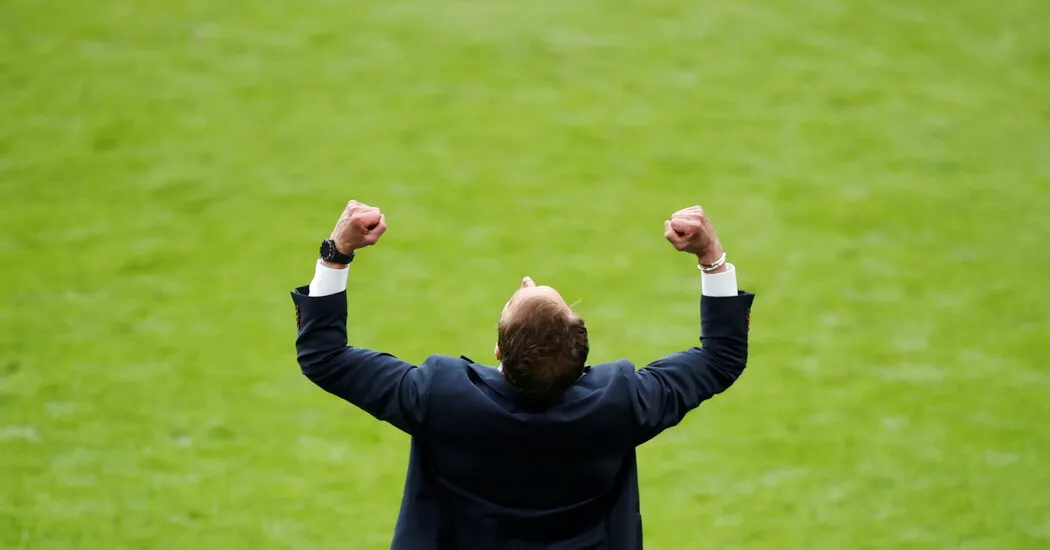
And it was that, all of that, which came pouring out after 75 excruciating minutes. Just as the nerves were starting to jangle and the ghosts starting to materialize, Jack Grealish funneled the ball to Luke Shaw, and Shaw crossed, low, and Raheem Sterling darted in between two German defenders and steered the ball past Manuel Neuer.
All of a sudden, Wembley did not seem half-empty, it appeared to be full, writhing and seething and alive, a sea of people bounding and jumping and screaming into the sky. A moment before, the game had been drifting into stasis, the teams circling each other, unwilling or unable to strike the first blow, and Wembley had been full of tension and doubt, just as it had been for half a century.
And then, as thoughts started to turn to extra time and to penalties and to an inevitable pain, the sort that you can steel yourself against but that you can never truly prepare for, it all lifted, instantaneously, an exhalation that doubled as an exorcism, a defeat not just of this Germany, not just of the idea of Germany, but of all the reasons to doubt, all the reasons to fear.
A few minutes later, Shaw and Grealish and, finally, Harry Kane combined to make it 2-0, and Wembley exploded once more, celebrating as if making up for lost time, as if toasting not just this victory but the ones that might have been, in Bloemfontein and the old Wembley and Turin and even León, in 1970, back in the distant mists of time.
Strictly speaking, 1996 is not a happy memory for England. It ended, as it always used to, in gloom. Still, the fans have adopted the refrain from that tournament — Football’s Coming Home — as their anthem of choice. Occasionally, they will throw in the first three words, too: We Still Believe.
England had not beaten Germany in a knockout game at a major tournament — when it really mattered — since 1966, the moment that all subsequent iterations of the England team have so conspicuously failed to meet. Now, it has. Its reward is not just a place in the quarterfinals. It is more than simply the defeat of the team it has come to see as its greatest dragon.
It is that, after 50-plus years, it does not need to carry with it all of those haunting defeats and those dispiriting setbacks and those plangent regrets. This group of players, the ones who do not remember, no longer need to bear with them the scars of the past. For the first time in a long time, the history does not matter.
Stay connected with us on social media platform for instant update click here to join our Twitter, & Facebook
Denial of responsibility!TechAzi is an automatic aggregator around the global media. All the content are available free on Internet. We have just arranged it in one platform for educational purpose only. In each content, the hyperlink to the primary source is specified. All trademarks belong to their rightful owners, all materials to their authors. If you are the owner of the content and do not want us to publish your materials on our website, please contact us by email – [email protected]. The content will be deleted within 24 hours.