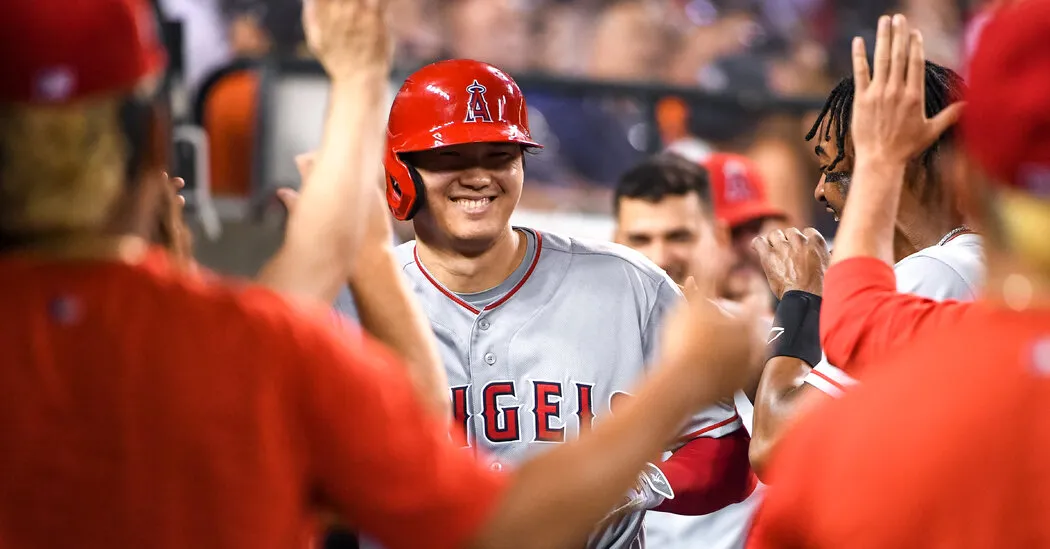
“The 21st century Babe Ruth.” “The modern-day Babe Ruth.” “The greatest two-way player since Babe Ruth.”
When reaching back through history for comparisons to Shohei Ohtani, who hit his 40th home run of the season on Wednesday, fans and sportswriters tend to find just one: Babe Ruth. One of the greatest sluggers in baseball history, of course, Ruth started his career as a first-rate pitcher. So Ohtani, the two-way sensation for the Los Angeles Angels, is simply Ruth reincarnated, right?
It is not quite that simple.
For three seasons, from 1915 to 1917, Ruth was a full-time starting pitcher for the Boston Red Sox. While he occasionally got a pinch-hit appearance, and wowed people with his power, pitching was his job.
He was 23-12 with a league-leading E.R.A. of 1.75 in 1917 and was 24-13 the next year. But while the Sox, who won World Series titles in 1915, 1916 and 1918, had to be happy with his pitching, Ruth’s hitting was starting to attract a lot of attention. In 1917, he hit .325 with some extra-base power. And Ruth himself wanted to focus more on hitting.
And that is where the comparison to Ohtani begins.
In terms of true two-way play, Ruth’s most Ohtani-like seasons were 1918 and 1919. His pitching load was cut roughly in half, to 34 combined starts over two seasons compared with 78 in the two previous years, and he played in the outfield (and occasionally first base) on other days. He went from about 150 plate appearances a season to 382 in 1918. In 1919, he was essentially a full-time position player, with 543 plate appearances.
It quickly became clear that his true value to the team came as a hitter.
In 1918, he had a career high on-base plus slugging percentage of .966 with 11 home runs, which led the majors in that radically different era. (In a take that didn’t age well, a New York Times headline said, “Ruth headed for extra base record which may stand for years to come.”) In 1919, the team ratcheted back his pitching, shutting him down for the most part by mid-June, and he upped his O.P.S. to 1.114 and his home runs to 29. At the same time, he was still a competent pitcher, with E.R.A.s of 2.22 and 2.97.
Ohtani’s 2021 doesn’t match up with any of those seasons.
After working through arm injuries in previous seasons, Ohtani is on pace to make about 24 starts this year, fewer than Ruth as a full-time pitcher but more than in Ruth’s part-time seasons. And Ohtani is on track for more than 600 plate appearances, which is more than Ruth had in any of his pitching years. Though in fairness to Ruth, Ohtani is almost exclusively used as a designated hitter, thus he doesn’t have the additional fielding burden that Ruth did.
Ohtani’s pitching numbers — 8-1 with a 2.79 E.R.A. — are near the top of the league, as Ruth’s were in his full-time pitching years. As a hitter, Ohtani leads the majors in homers and the American League in slugging percentage, a Ruthian feat for certain.
While Ruth would quite likely have been capable of doing full-time duty as a pitcher and hitter, he never got the chance: His days as even a part-time pitcher came to an abrupt end in 1920.
The cash-poor Red Sox, weary of Ruth’s contract demands, sold him to the Yankees in an infamous deal. By then, Ruth’s batting had overshadowed his pitching, and the Yanks put him in the outfield for good. He made just five token pitching appearances in his 15 years with the club. (For the record, he was 5-0 in them.)
From his first year as a full-time outfielder with the Yankees, he revolutionized hitting, slugging 54 homers in 1920. His O.P.S. was 1.379, mouthwatering in any era. He had become the greatest hitter the game had ever known, and his pitching career slipped away to a footnote.
In the nearly 100 years between the careers of Ruth and Ohtani, the National and American leagues offered shockingly little in terms of players who excelled at pitching and hitting, and none who did both at the same time. But the Negro leagues did offer a few standouts,in part because they had smaller rosters and tighter budgets. Bullet Joe Rogan regularly hit .300 and had an E.R.A. in the 2s as a starter, outfielder and second baseman for the Kansas City Monarchs. Martin Dihigo was a star at any position he played, including pitcher.
But with databases of those leagues’ statistics still being built out, Ohtani is constantly compared to Ruth. And it is Ruth’s offensive explosion in 1920, when he went exclusively to hitting, that raises the question of whether Ohtani could improve if he stuck to one lane.
In modern sports there is a tendency to push back at versatility: For pro stars, “How good could Bo Jackson have been if he hadn’t played football as a ‘hobby’”; or even for children, “If your kids are going to get really good at soccer they need to join a year-round traveling team and drop basketball and lacrosse.” The Hall of Fame pitcher John Smoltz suggested earlier in the season that Ohtani should consider pitching exclusively.
But could there realistically be much of an upside to a specialist Ohtani? He is already hitting and pitching extremely well. Losing 40 homers (and maybe 50 by the end of the year) doesn’t seem like a smart move, and would one of the best pitchers in the league really get a lot better by dropping the four or five at-bats he takes on his off days?
It is also not 100 percent clear that Ruth’s drastic improvement was entirely, or even partly, because he stopped pitching. He was 25 in 1920, about the age when player stats often improve significantly. And led by Ruth, hitting in baseball was changing quickly. More batters abandoned the traditional contact-based approach to hitting, seeking the long ball even if it meant more strikeouts. One would guess that Ruth would still have clobbered a lot of home runs in the 1920s if he had been sent out to pitch every few days.
The other trouble with comparisons is that they don’t work as well with the all-time greats. It’s easy to find five players similar to a merely good player like, say, B.J. Surhoff or Josh Reddick. Finding someone who’s a lot like Willie Mays or Roger Clemens is pretty much impossible.
But the comparisons between Ohtani and Ruth do underscore something quite remarkable: Players like them don’t come along very often.
Stay connected with us on social media platform for instant update click here to join our Twitter, & Facebook
Denial of responsibility!TechAzi is an automatic aggregator around the global media. All the content are available free on Internet. We have just arranged it in one platform for educational purpose only. In each content, the hyperlink to the primary source is specified. All trademarks belong to their rightful owners, all materials to their authors. If you are the owner of the content and do not want us to publish your materials on our website, please contact us by email – [email protected]. The content will be deleted within 24 hours.