FLORENCE — Italy’s match against England in the Euro 2021 finals is a couple of days in the future, but on Friday fans of the team were visiting its past at the national football hall of fame in Florence.
They were musing over the uniforms worn by Italy’s national soccer team since 1928 and admiring the shin guards used by the team captain in the 2006 World Cup, which Italy won. Then someone peeked outside: There, in the distance, was someone they recognized.
“His hair is flying,” said Gabriele Faralli, a hospital doctor in the nearby town of Arezzo who had come to the museum with his two sons. “That’s Coach Mancini,” he said of Roberto Mancini, manager of the Italian national team, the Azzurri (or the Blues). Mr. Mancini, who stays with the team at the Blues’ headquarters in Florence during tournaments, was training in their nearby field.
In a moment, all of the tourists at the museum, the Museo del Calcio, were trying to catch a glimpse of Coach Mancini, on whose shoulders rest the hopes of a nation badly battered by the coronavirus but making its way out of the pandemic.
Mr. Faralli’s elder son Giulio, 8, expressed the fears likely haunting many Italian soccer fans as the match grows closer.
“I am so worried about Sterling,” he said referring to Raheem Sterling, a forward for England’s national team. “He dribbles fast and defends the ball — and about Kane, so much technique and experience, and he scores,” a reference to Harry Kane, England’s captain.
As Italy moved ever closer to the finals, more and more visitors, like the Faralli family, have flocked to the museum.
“A winning national team attracts people from near and afar. That’s why visitors are growing,” said Silvia Maci, the museum’s longtime secretary and a close collaborator of Fino Fini, a physician who worked for the national team for 40 years and had the idea of creating the museum in the 1990s.
The doctor, a team institution, collected donations from the players and their families to build a collection that could set an example for new generations and highlight the soccer glories of the past.
Woolen jerseys in blue, white and even in black (from the fascist era) hang from the museum’s walls, some washed so many times that they had shrunk. On a 1935 light blue jersey, the mother of the player Silvio Piola embroidered her son’s success, “Austria 0 Italy 2. Piola scored both goals. Piola’s first match with the national team.”
In 1982, Italy won the World Cup after beating Germany. To memorialize that time, two iconic pipes rest in a case, lying on a faux green field.
“That happiness in 1982, I still remember it,” said Simona Rossi, a teacher from the nearby city of Arezzo who was visiting the museum with her family. “The papers carried a picture of President Pertini and Coach Bearzot smoking those pipes. It was a symbol,” she said, referring to President Alessandro Pertini of Italy and Coach Enzo Bearzot, who led the team to victory.
Enthused by the team’s victory in the World Cup, President Pertini flew the players back on the presidential plane and played cards with some of them, the World Cup resting on the table.
Every year is a big soccer year in Italy. When the national league finishes, victorious fans parade through city streets in their cars and mopeds. But it is during the international competitions that the Italian soccer fanaticism takes on a semblance of religious faith.
“God Is Italian,” read the headline of a national sports newspaper earlier this week, exalting a victory over Spain in the semifinals.
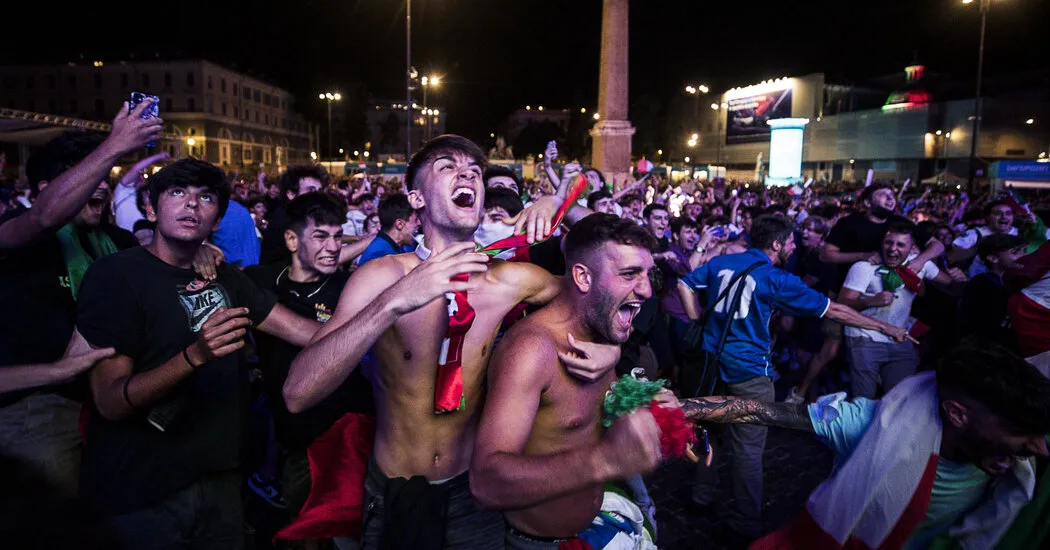
Despite pandemic restrictions that still require masks and social distancing, especially indoors, people have been watching the games in large crowds and celebrating on the streets.
“With all caution, people need some normality and the national team this year is a reason to be proud and joyful after so much suffering,” said Daniele Magnani, an amateur soccer coach, who was visiting the museum with his wife.
Mr. Magnani said that he had always watched the international competitions at home, but this year he was going to a public viewing in a large garden in the eastern Italian city of Cesena where he lives with his family.
He noted that Coach Mancini not only managed to rebuild the national team, he also galvanized Italians. Last year, in homage to the city of Bergamo’s early fight against Covid-19, the team chose to play one of its first international matches in town, with only medical workers watching.
Italy has had more recent success than England, but also some recent failures. In 2017 the team suffered the humiliation of going home from the World Cup at the end of the group stage.
“There is a future for Italian soccer,” Gianluigi Buffon, Italy’s beloved goalkeeper, said in tears during a television interview after the defeat, while the interviewer placed a hand on his shoulder.
“We have pride and strength, we are stubborn,” Mr. Buffon said. “After such bad falls, we will find a way to get back up.”
“I’ve been playing soccer for three years,” the young Giulio Faralli said, showing the three with his fingers. “Can you imagine if they win on Sunday?”
Stay connected with us on social media platform for instant update click here to join our Twitter, & Facebook
Denial of responsibility!TechAzi is an automatic aggregator around the global media. All the content are available free on Internet. We have just arranged it in one platform for educational purpose only. In each content, the hyperlink to the primary source is specified. All trademarks belong to their rightful owners, all materials to their authors. If you are the owner of the content and do not want us to publish your materials on our website, please contact us by email – [email protected]. The content will be deleted within 24 hours.