Like many soccer fans around the world, Paolo Falco, a labor economist at the University of Copenhagen, was delighted by the outcome of the European Championship final last Sunday, which saw Italy defeat England in a climactic penalty shootout. And he was appalled in equal measure by the aftermath.
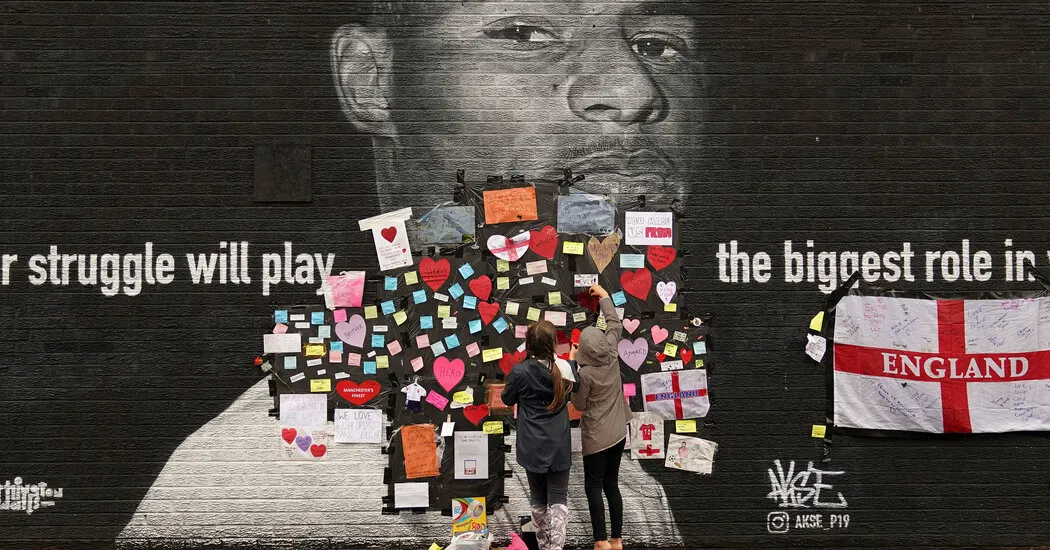
In the hours following the match the three England players, all Black, who missed their penalty shots were heaped with racial abuse on social media. The abuse prompted outrage from Prince William and British Prime Minister Boris Johnson, and revived a too-familiar aphorism: “When you win, you’re English; when you lose, you’re Black.”
In recent years, UEFA, the governing body of European soccer, has worked to combat racism against its players, both online and in stadiums. But the behavior persists; in Italy and elsewhere, world-class players of color have been subjected to racist chants and epithets, and to even have bananas thrown onto the field. “I have experienced firsthand all sorts of terrible things being said and cursed and yelled at players,” said Dr. Falco, who closely follows Serie A, Italy’s top league.
In December, he and two colleagues — Mauro Caselli and Gianpiero Mattera, economists at the University of Trento, in Italy, and the Organization for Economic Cooperation and Development in Paris, respectively — posted one of the first studies seeking to measure the impact of in-stadium abuse on the game. Their working paper, which awaits publication in a peer-reviewed journal, compared the performances of roughly 500 Serie A players in the first half of the 2019-2020 season of the main Italian championship league — before the Covid-19 pandemic, when stadiums were full and raucous — to the second half, when “ghost games” were played in empty stadiums.
Their results were stark: One subgroup of players, and one only, played noticeably better in the absence of crowds. “We find that players from Africa, who are most commonly targeted by racial harassment, experience a significant improvement in performance when supporters are no longer at the stadium,” the authors wrote.
Dr. Falco spoke by phone from Copenhagen on Thursday. The following conversation has been edited for brevity and clarity.
What inspired your study?
I was watching a football match after the lockdown began, and I was struck by how different an experience I was having, even on TV, by simply not hearing all the noises and all the chanting that typically goes on in the background of a football match.
I’m from Napoli, and football fans in Napoli definitely are very loud. In that kind of stadium, you see emotions expressed at their best and at their worst. And you cannot help feeling that has an impact on what’s happening on the ground in the stadium.
I started wondering: Would it make a difference to all the players equally? Who are the players that are going to suffer more or less, or gain more or less, from having or not having the pressure of fans?
What was your working hypothesis?
That players who are targeted because of their color will perform better when the pressure is removed — independent of the general pressure of playing in a stadium, which is the same for all players.
That question is incredibly difficult to address in normal circumstances, because you don’t have the experiment that you would like to have: seeing how those players perform relative to themselves, before and after, with and without fans. Covid gave us precisely that natural experiment. From one day to the next, the players went from full stadiums to empty stadiums.
We got curious, and we started analyzing the data. And we found that, indeed, players are affected differentially, with the ones that are most subject to abuse seemingly experiencing an improvement in their performance the moment that they don’t have this pressure on them anymore. This effect survived even after we controlled for a host of potentially confounding factors — weather, the time of day the match was played, the strength of the opposing team — so we strongly believe it’s there.
What metric did you use as a measure of player performance?
There are very detailed statistics, created by a publicly available algorithm, on the performance of every player after every match. It’s much more than just goals scored, and is very objective: How far did the player run during the game? How many passes did they complete?
These are statistics from a database commonly used for fantasy-team ratings and for betting purposes, is that right?
Yes, that’s correct.
There is an interesting and growing literature on the effect that football fans have on teams as a whole. For instance, it has been shown that referees are not as favorable to the home team in the absence of spectators, and that the home advantage is not as pronounced in terms of who wins. What we wanted to do was look at the individual players, to see any differences in performance between those who are from certain ethnic backgrounds.
I want to go back to the very end of that game between England and Italy. Imagine for a second what goes on in the mind of those players as they approach that penalty, knowing not only that they have the same pressure as every other football player in the field but also that they’re Black, that they’re in a minority, and they very likely are going to be treated exactly the way that they were treated the moment that they make a mistake.
Think about the incredible pressure that is placed upon those players. It makes you almost shiver. That’s why I don’t think it was too big a leap of imagination to think that we could find something of this kind in the data.
What did your results show?
We found that African players performed 3 percent better in the second part of the season compared to the first part. You may think, OK, 3 percent isn’t such a big deal. But if you were talking about the productivity or profits of a firm and its workers, 3 percent would be huge. If you see football players as workers, which is ultimately what they are, and they are 3 percent less productive, that has repercussions for the team as a whole.
These are economic costs, not just moral or ethical concerns. Players of African origin play worse in front of spectators, but nobody else performs better, so overall the quality of the game decreases. This is something that should bother club owners, because they are making investments in players.
We also looked at players for teams that we know were particularly subject to abuse at the beginning of the season. The Italian authorities actually record episodes of abuse from fans in the stadium, so we know which teams were playing in matches before the lockdown where there was such racist behavior. And it was the players on those teams, including Napoli, that saw the biggest improvement in performance the most — 10 percent better — in the absence of spectators.
We’re talking about the elite of the elite athletes in the country. They are in the best of the best position in terms of social status and money earned. So the fact that these athletes are affected is extremely worrying; if one were to look at the lower leagues, there must be a lot more of this going on.
Do you feel that your study group, with African players making up only 7 percent of the total, was sufficiently robust to provide meaningful results?
That’s a good question. But the number of players only plays a role up to an extent, because these are players that we observe many times during the year — every week, 38 observations for each player over the course of the season, roughly half before lockdown and half after. The statistical power of the analysis is very strong because we are comparing the exact same people, not just two random samples, before and after.
As fans in the stadium, we all like to think that we are more than just spectators — that our voices have a real impact on the game. Your research suggests that we actually do, and uncomfortably so.
Sometimes I get a little bit worried about what we have done here, as we may inadvertently reassure people in their conviction that shouting racist things is going to help their team win. On the other hand, I firmly believe that research should aim to uncover facts and always be transparent about them. In this case, I hope that the people in charge of the economics of this game will understand that racism is costing them money and damaging their investments. When certain players cannot express their full potential, the game is simply not as beautiful and appealing as it could be.
What we’re metabolizing lately
Science in The Times, 67 years ago this week
The inquiries arose because, in the recent shot-putting event, a national British record of 55 feet would have been established but for the fact that the 16-pound weight was found to have been half an ounce too light.
Stay connected with us on social media platform for instant update click here to join our Twitter, & Facebook
Denial of responsibility!TechAzi is an automatic aggregator around the global media. All the content are available free on Internet. We have just arranged it in one platform for educational purpose only. In each content, the hyperlink to the primary source is specified. All trademarks belong to their rightful owners, all materials to their authors. If you are the owner of the content and do not want us to publish your materials on our website, please contact us by email – [email protected]. The content will be deleted within 24 hours.