MediaTek Dimensity 5G Open Resource Architecture unlocks exceptional customised consumer experiences | 91mobiles.com
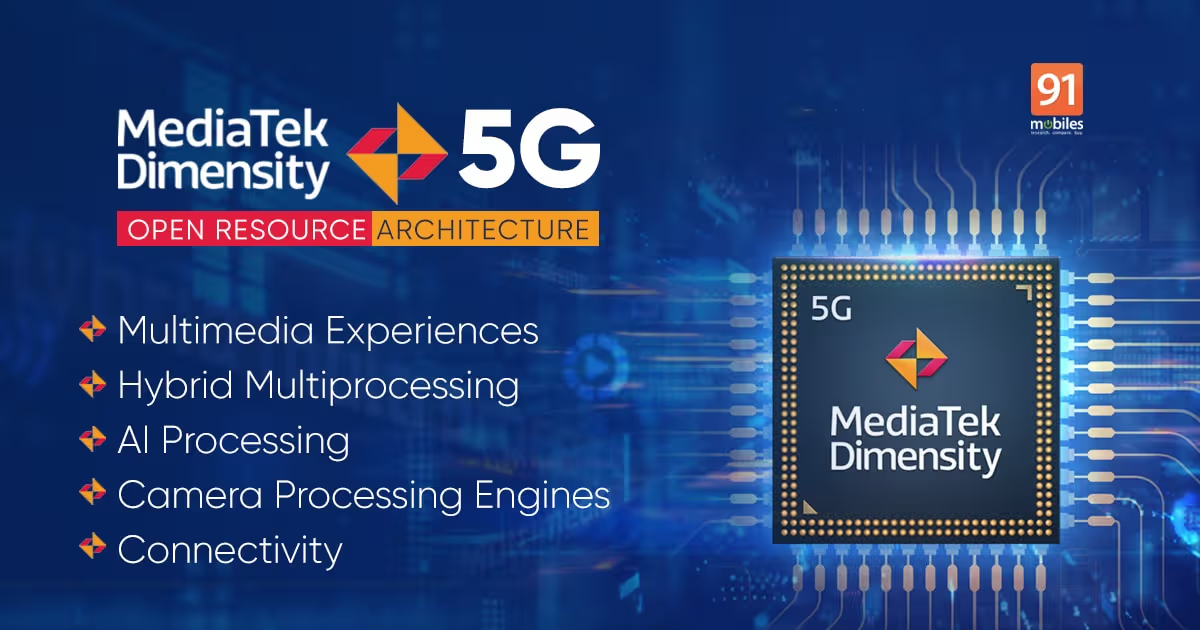
Most smartphone users do not realise that a smartphone’s processor is much more than its clock speed. It’s the chipset that determines whether your phone supports 5G connectivity, secure facial or fingerprint recognition, multi-camera designs, HDR displays, and much more. Because of this, two smartphones with the same processor consistently offer a similar feature set, establishing uniformity across brands. It also leaves very little space for smartphone manufacturers to deliver a unique smartphone experience that stands out. MediaTek is aiming to solve this issue with its Dimensity 5G Open Resource Architecture; here, we explain the initiative to understand how it can help brands unlock customised consumer experiences.
What is MediaTek Dimensity 5G Open Resource Architecture?
MediaTek Dimensity 5G Open Resource Architecture aims to help smartphone brands create outstanding flagship and premium 5G smartphones that deliver a unique user experience. The open resource architecture gives smartphone brands closer-to-metal access to customise features for cameras, displays, graphics, artificial intelligence (AI) processing units (APUs), sensors, and connectivity sub-systems. With access to these sub-systems, smartphone vendors will be able to deliver a customised experience that is tailored to their users’ lifestyles. The MediaTek Dimensity 5G Open Resource Architecture also allows manufacturers to innovate and produce smartphones that stand out from the rest. Here are all the key areas smartphone vendors can access through the MediaTek Dimensity 5G Open Resource Architecture to make unique 5G smartphones.
Multimedia Experiences
MediaTek Dimensity 5G Open Resource Architecture gives smartphone manufacturers access to in-chip, multi-core AI and display processors. Now, the brands can choose to use MediaTek’s own AI Picture Quality (AI-PQ) and AI Super Resolution (AI-SR), or they can deliver their own customised experience. Brands can use their deep learning data in conjunction with their display hardware to dynamically adjust display elements like contrast, colour, sharpness, brightness and more. It unlocks a whole new world of multimedia experiences as brands can factor in their display hardware and tune the multimedia performance accordingly.
Hybrid Multiprocessing
The open resource architecture gives brands deep access to central processing unit (CPU), graphics processing unit (GPU), deep learning accelerators, and visual processors. Now, device makers can customise workload assignments across the varied processing elements within the chip. It gives them the ability to match the performance and power efficiency of their smartphones with the software and services they want to deliver.
AI Processing
Another way MediaTek is empowering device makers to bring improved performance and power efficiency is by allowing them greater access to the Deep Learning Accelerator (DLA) found inside the MediaTek APU. Utilising the foundation of MediaTek’s NeuroPilot ecosystem, manufacturers can apply customisations to the multi-threaded scheduler, use customised algorithms, or embrace the MediaTek Deep Learning Accelerator (DLA) with its unique capacity to process FP16 tasks in addition to typical INT8 and INT16, all within a single engine. Don’t worry if you cannot understand these technical terms, know that it will allow smartphone brands to deliver improved precision, performance, and power efficiency.