Throwback : Swatilekha Sengupta on working in films, Soumitra Chatterjee and more
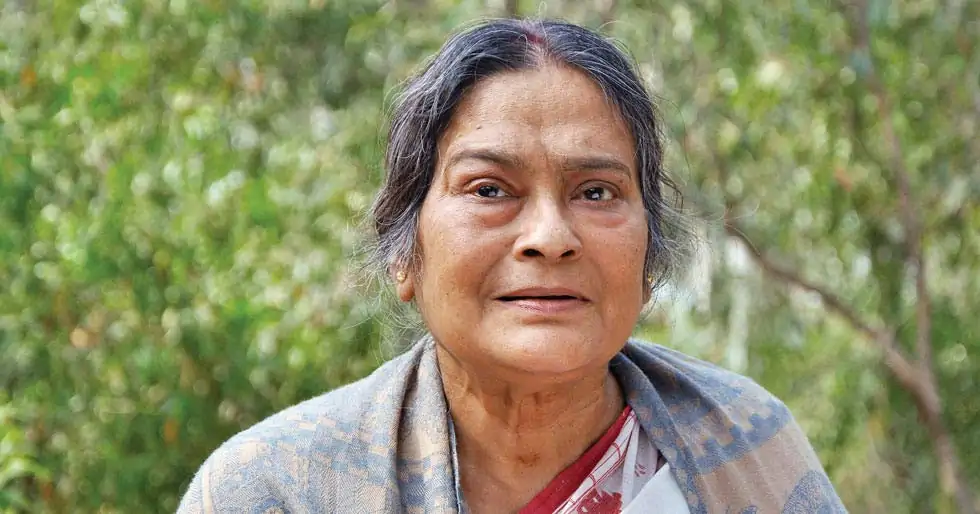
Satyajit Ray aficionados would remember Swatilekha Sengupta as the comely wife caught in a love triangle between her rich husband (Victor Banerjee) and his freedom-fighter friend Soumitra Chatterjee in Ghare Baire (1985). The film showed her caught in a whirlwind of emotions as she had to choose between her sedate husband and the charismatic admirer. It was a sensitive performance and won her admiration on the festival circuit. Her lip-lock with Soumitra in the film did ruffle a few feathers. Negative reviews of her performance at home affected her strongly and she didn’t sign a film for close to 30 years after that. She was recently seen in Bela Seshe (2015, The End) directed by Nandita Roy and Shiboprosad Mukherjee. In this she was reunited with Soumitra. The 70-year-old actor, who is known more for her plays than films, suffered a heart attack some time ago. The actrress is better now. And she’s excited about her upcoming movie Bela Shuru (The Beginning).Starring her and Soumitra Chatterjee once again, the film is a sort of spiritual successor to the team’s earlier film. Excerpts from an interview with Swatilekha – a Sangeet Natak Akademi Award winner, who has lost none of her pizzazz to the passage of time.
A girl from Allahabad would’ve travelled to Mumbai and not Kolkata to be an actress. What made you do the contrary?
I came here in 1975-76 after completing my MA from Allahabad University. I was always interested in theatre. Eventually, I joined the Nandikar group (she worked under the direction of Rudraprasad Sengupta, one of the founders, whom she later married). Sombhu Mitra was an icon of the theatre world at that time. I did German dramatist Bertolt Brecht’s Galileo with him. I hardly had any role in the play. But Satyajit Ray watched it and he wanted me to play Bimala in Ghare Baire (1985).
Do you remember your first meeting with Satyajit Ray?
I didn’t want to take my final exams in school. So I’d written a letter to Ray saying, “Please take me in your film, I don’t want to do this exam.” But I didn’t get any reply. Years later, I got a call from actor Rabi Ghosh saying Satyajit Ray wants to meet you. I didn’t believe him. But eventually I agreed. There was a bandh the day I was to meet Ray. I walked 14 kilometres to reach his place. When he opened the door, he looked like he’d seen a ghost. He said, “How could you come today? Everything is closed.” I said, “Okay, I’ll go back.” He said, “No, no, sit.” He started making my sketches and said, “You’re my heroine.” He gave me the script of Ghare Baire, which was based on Rabindranath Tagore’s novel of the same name.
What was Satyajit Ray like as a person and as a filmmaker?
He was Tagore, Picasso, Beethoven, all rolled into one. He was a fine artist too. He used to paint all his scenes before shooting them. He used to even paint the blouse and sarees of his female characters. The fabric used to be bought according to the painting. He himself searched for the Victoria brand cigarettes just for one shot in Ghare Baire. Also, there’s a little box of jewels in the film. He hired that box for 8000 rupees for one day. But he never wasted money on taking retakes. He was kanjoos. He was a one-take director. I was in touch with him even after the film. But I was shy about showing how important he was for me. I’d tell him, “Manikda please forgive me. But I can’t do this, ‘Dada, Dada’ business all the time. Whatever there is for you, it’s in my heart. I can’t express it.” He said, “But how will I know that you want to do another film.” I said, “That’s true. I want to do another film.” But he passed away before that. It was sad.
Didn’t you have any qualms about the kissing scene in the film?
Any memories of the Ghare Baire premiere at Cannes?
American actor Bette Davis was travelling in the same plane with us. When we got down in Paris to change planes, we got served small cakes, which I relished. I knew I shouldn’t be eating so many of them. But I couldn’t control myself. Everything was new to me. The room I was staying in had a warm water bed. I was asked to wear a Benarasi saree for the red carpet. I picked my best one. When the film started, it was the first time I was seeing myself on the big screen. I thought I was the ugliest woman around. But the audience loved the film. When we were leaving the theatre, several women hugged and kissed me.
The press in Kolkata wasn’t kind towards your performance…
They wrote any kind of rubbish they wanted to. Every time I got those nasty letters, Satyajit Ray would send me a personal letter saying, ‘This happens with everyone, don’t worry. Just move ahead’. With stress, my skin turned bad. He took me to a lady (counsellor) for a sitting. He did everything possible to make me feel better. He told people she’s my most intelligent actress
till date.
Cinema never attracted you much afterwards?
It attracted me. But I believed I didn’t have the looks for cinema. Also,
I guess people were afraid of my forthright ways and of my stature in theatre. Theatre is something I’ve done since the age of five. My mother, Roma Haldar, was a theatre personality and a costume designer. She used to play the piano and sing beautifully. My guru, Anukul Chandra Banerjee from Allahabad, was like my second father. He introduced me to theatre. My mother was more interested in me doing theatre than in me taking exams. I had a unique childhood.