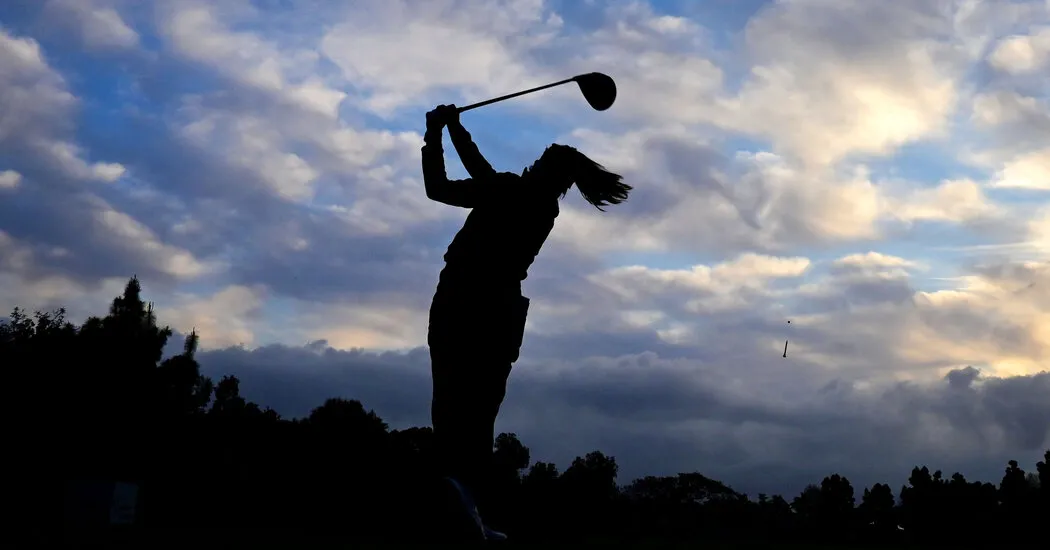
Emma Talley had never concerned herself with length off the tee until after her rookie season on the L.P.G.A. Tour.
She had always been an accurate hitter and that year, 2018, she finished 52nd on the money list, which earned her more than $420,000 in prize money. She had four top-10 finishes and was off to a great start as a professional golfer.
But playing among the best women golfers in the world, she began to wonder if her game could get even better if she could hit the ball farther.
“When I first came out here, I was a little above average distance-wise, but I wasn’t a long hitter,” said Talley, who will be at this week’s Amundi Evian Championship at the Evian Resort Golf Club in France. “At the end of my rookie year I looked at the top five players and they all hit it long. So, I tried to gain distance.”
She watched players like Nelly Korda and Ariya Jutanugarn hit their tee shots 20 or 30 yards past hers, which in turn left them shorter and easier second shots into the green. “I started hitting it all over the place,” she said. “I couldn’t figure out how to gain distance with the accuracy I had had before.”
By the end of her second season, she had lost her tour card and had to earn back her playing privileges.
Distance in golf is the holy grail: The longer a player hits the ball, the more it fascinates fans and fellow players. Like a sprinter’s time or a home run in baseball, a player’s length off the tee is a statistic that stands out against all others.
“The L.P.G.A. Tour is typically a straight hitters tour,” said Grant Boone, a commentator on the Golf Channel. “There have always been women who hit it far. Laura Davies is the first to come to mind, and Mickey Wright could really move it 50, 60 years ago. But what we’re about to see on the L.P.G.A. Tour is what we’ve seen on the men’s tour. We are entering a power era.”
It may be coming, but the ranks of successful women golfers show something that is not seen among professional male players: a huge disparity in length off the tee. But hitting with more power does not necessarily determine who wins a tournament. Sometimes it’s the more accurate golfer. Of course, combing the two can make a player formidable.
The difference between the longest hitter on the L.P.G.A. Tour and the 168th ranked player, who is the last one on the list, is 60 yards. On the Ladies European Tour, which co-sanctions the Evian with the L.P.G.A., the difference is 79 yards between first and 168th place.
But even those numbers may downplay how far the longest hitters drive the ball, because the bombers do not always have to reach for their drivers to get maximum distance; they can play it safe with a 3-wood or iron and still be way out there.
By contrast, the difference between the longest hitter on the PGA Tour and number 168 is 33 yards. And almost all of those players are capable of hitting the ball 300 yards or more.
Some of the shortest hitters on the L.P.G.A. like Inbee Park, No. 156, and Paula Creamer, No. 166, have had some of the longest and most productive careers. Park has hovered within the top 10 in the world for most of her career, reaching the top spot four times. She also has 20 wins and seven major titles, including the Evian in 2012.
Creamer, who won the Evian in 2005, has 10 wins and a major, winning the 2010 U.S. Women’s Open.
Davies, 57, is still one of the longer hitters on the L.P.G.A. Tour, even though she is competing against women half her age (or younger). She said distance was never a disadvantage, but she said hitting it long at L.P.G.A. and LE.T. tournaments did not present the same advantage it did on the men’s tours.
“You don’t have to hit it miles to do well, said Davies, who has won 85 tournaments worldwide. “On the men’s tour, they all hit it a long way, and then you have super long-hitters like Bryson [DeChambeau] and Dustin [Johnson]. Whereas on our tour, there’s a substantial distance between Paula Creamer and Lexi Thompson.”
Davies won the Evian in 1995 and 1996, but will miss this year’s event because of Covid concerns. She said the setup of courses like the one at the Evian golf club would benefit from challenging the longer hitters to hit more risky shots, knowing their misses could be more costly.
“I’d prefer a few longer par 4s and some reachable par 5s,” she said. “Our par 5s are so inaccessible that’s its frustrating. On the PGA Tour, it’s eagles here, eagles there. Make the par 5s into risk-reward holes for us.”
Grant Waite, a former PGA Tour player who now coaches several top L.P.G.A. players, including long-hitting Patty Tavatanakit, said female players were making distance gains greater than those of professional men. It’s the result of creating swings that are more efficient and launch the ball higher for greater distance.
Waite said that the typical amateur male player swings about 94 miles per hour, while typical female professional golfers swing only slightly faster at around 96 miles per hour. But the L.P.G.A. pro hits the ball 20 to 30 yards farther than the average amateur man.
Female pros “learn to swing a certain way so they can hit up properly on the ball,” he said. “They’re also doing it by being very precise in a way that few can do.”
He singled out Park, who he called the best player of the past 10 years. “She doesn’t hit it very long,” he said. “She drives the ball straight. She doesn’t make mistakes with longer irons, and she’s very good with wedges and her putter. It’s a pretty simple model.”
Easier said than done. Gerina Piller, who turned pro in 2010, said she used to not worry about length, but that younger players have her thinking differently about how she trained and prepared for tournaments.
Piller, 36, said that when she first came out on tour there were four categories of players: “Girls who get it out there. Girls who hit it great. Girls who hit it long. And girls who bomb it.”
Now, she said, there’s not a huge difference between the long hitters and the bombers. She credits club technology, but also the acceptance of working out to get stronger.
“Now it’s all the craze, and I’ve jumped on that boat,” she said. “I haven’t gained a bunch of yardage, but I’m getting older, and my body needs that stability.”
Piller, who is in the middle of the field in terms of distance, said what’s become more important to her than chasing distance was practicing with an idea of what she wanted to improve.
“A lot of players at our level, we’re told we have to put the hours in, but we’re not told what to do,” she said. “You kind of have to experiment and find that out. Now I feel like I’m sharpening and shining every part of my game. But there are still some dull parts that I’m shining.”
Golf, of course, is a game where perfection is attainable only occasionally, and truly great days are elusive.
After regaining her tour card, Talley said she went back to her old coach and began trying to recreate the swing that had served her so well in the past. After all, it had made her a college standout at the University of Alabama.
“I look back now and say that was so silly to chase distance,” she said. “In my second year on tour, I would have known the golf courses better. I would have been used to traveling the world. Looking back I regret it, but I did learn a lot about myself.”
Stay connected with us on social media platform for instant update click here to join our Twitter, & Facebook
Denial of responsibility!TechAzi is an automatic aggregator around the global media. All the content are available free on Internet. We have just arranged it in one platform for educational purpose only. In each content, the hyperlink to the primary source is specified. All trademarks belong to their rightful owners, all materials to their authors. If you are the owner of the content and do not want us to publish your materials on our website, please contact us by email – [email protected]. The content will be deleted within 24 hours.