Holidays: How will my holidays to Europe be affected after Brexit?
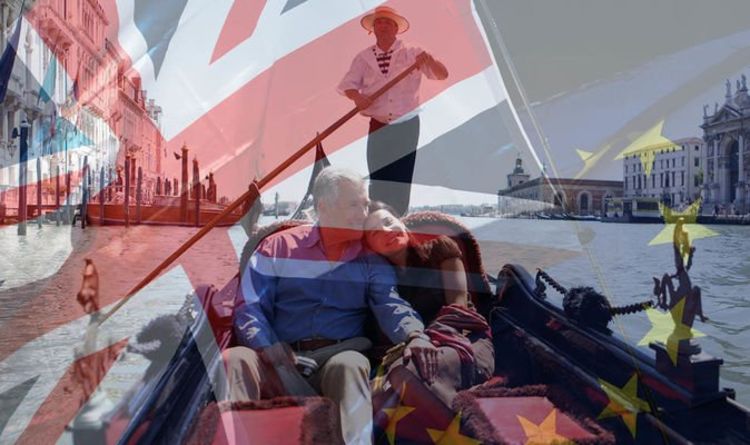
Prime Minister Boris Johnson said a no-deal outcome is “looking very, very likely” ahead of the Sunday deadline. Negotiations between the UK and EU have reached deadlock meaning once the transition period ends the UK will likely have no trade deal in place. But how exactly will Brexit affect your holidays to Europe?
Brexit negotiations are teetering on collapse which could impact several elements of travel.
Travel rules and regulations will change from January 1, 2021, once the Brexit transition period ends.
Currently, under the transition arrangements, British travellers are exempt from Covid-19 restrictions which ban non-essential visits to the EU from most countries in the world.
This exemption will cease immediately from January 1.
Theoretically, all travel corridors between the UK and Europe, Madeira and the Canary Islands would close.
READ MORE: From the start EU and Mr Barnier had one aim – to cripple the UK
Passports and visas
You will not need to buy another passport as long as your current passport is less than 10 years old and has six months left until it runs out.
The six-month rule does not apply to visits to Ireland as it is part of the Common Travel Area.
If you renew your passport you should expect it to be a different colour.
The Passport Office has urged Britons to request new passports now, as the current turnaround time already stands at approximately three weeks for online applications.
Tourists will not need a visa for short trips to EU countries, Iceland, Lichtenstein, Norway and Switzerland.
You can stay for up to 90 days in any 180-day period.
After Brexit, UK passport holders will need to apply for a new ETIAS (European Travel Information and Authorisation System) visa waiver.
Some restrictions on work are also probable from January 1 meaning British citizens will no longer be able to work in EU countries without a permit.
DON’T MISS
EU contingency measures in full: What are EU’s contingency measures? [INSIGHT]
Where is Wallonia? Inside the tiny Parliament threatening Brexit deal [EXPLAINER]
What does no deal Brexit mean for the UK? [ANALYSIS]
Passport control
You will face longer queues at passport control as Britons will no longer be permitted to use the EU fast-track passport control and customs lanes.
Instead, when you arrive in an EU country you should be prepared to show your return ticket.
You may also be permitted to show you have enough funds for your stay.
Healthcare
British passport holders are currently entitled to free or cheaper medical treatment in EU countries.
This entitlement is represented by a European Health Insurance Card (EHIC).
From December 31, you will need to buy travel insurance instead, making sure it includes comprehensive health coverage.
The cost of this insurance will likely rise in 2021.
Mobile phones
UK mobile phone users will no longer be permitted to automatic free-roaming from January 1.
The guarantee of free-roaming throughout the EU, Iceland, Liechtenstein and Norway ends on 1 January 2021.
The four main UK mobile operators have said they have no plans to reintroduce roaming fees.
Travellers to Europe should check with your mobile provider before you travel, to see if you are likely to face extra charges.
Driving licences
If you wish to drive across Europe from 2021 you may be required to get an international driving permit (IDP).
The permit is obtainable from the Post Office, costing £5.50.
If you drive your car abroad you may be required to arrange additional insurance coverage and carry a Green Card to prove you have obtained this coverage.
READ MORE: House prices: Property prices expected to drop by 6%
Pets
From January 1, pets will no longer be able to travel using the existing passport scheme.
Instead, a different process will need to be followed.
This process takes around four months and currently, the exact arrangements remain uncertain.
Duty-free shopping
Britons have not been permitted to buy duty-free items when travelling between EU countries since 1999.
However, Britons were able to bring home virtually unlimited amounts of duty paid goods such as wine from France where it is significantly cheaper than in the UK.
From 2021, the Government will be able to buy duty-free tobacco and alcohol when travelling to the EU, but it is still unclear exactly what the allowances will be and if there will be any changes to duty paid arrangements.
Stay connected with us on social media platform for instant update click here to join our ????️????️ Twitter, & Facebook
We are now on Telegram. Click here to join our channel (@TechiUpdate) and stay updated with the latest Life Style headlines.
For all the latest Life Style News Click Here
For the latest news and updates, follow us on Google News.
Also, if you like our efforts, consider sharing this story with your friends, this will encourage us to bring more exciting updates for you.