Contact UsDMCA policyAbout UsPrivacy PolicyTerms of UseDisclaimerCookie Policy
Trending

Relief for Belgium Comes at Ronaldo’s Expense
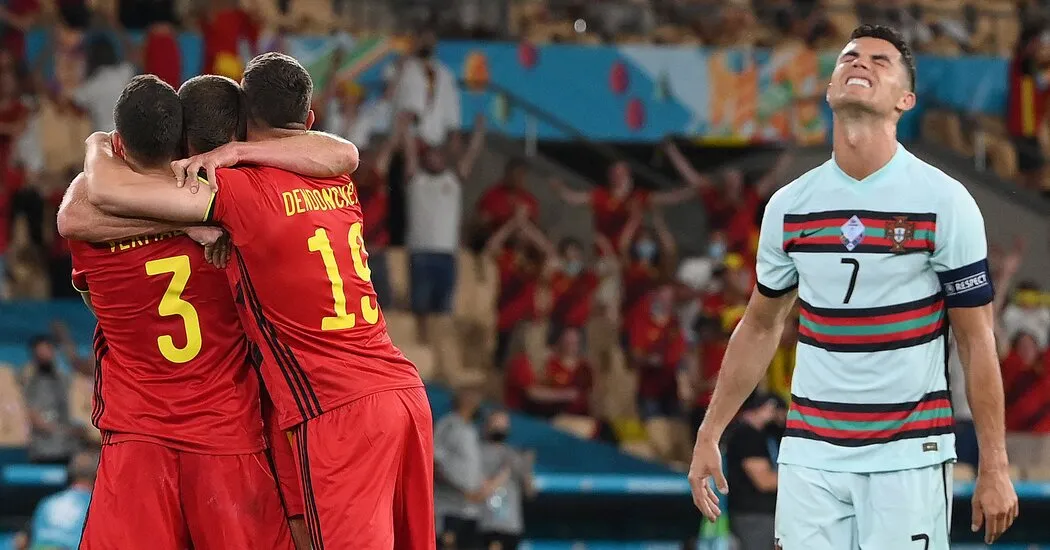
Relief for Belgium Comes at Ronaldo’s Expense

The list of people who had let Cristiano Ronaldo down was, by the end, a long and illustrious one.

Their transgressions had varied, in both nature and severity, and so had their punishments: Diogo Jota, failure to pass, hard stare; Renato Sanches, not getting out of the way of a free kick, baleful finger-point; Bruno Fernandes, speculative and wildly inaccurate shooting not entirely unfamiliar to Ronaldo himself, primal scream into Seville’s stifling night sky.

Ronaldo, in his defense, had much to complain about. Portugal was in the process of surrendering the European crown it had scrapped and scrambled to win in France five years ago with hardly a whimper, meekly exiting the competition in the first knockout round with a 1-0 defeat to a surprisingly fragile Belgium team, and none of his teammates were beyond reproach.

Jota had been wasteful. Bernardo Silva had been ineffectual to the point of anonymity. Fernandes had injected a little vim and vigor after his introduction as a second-half substitute, but his energy was faintly chaotic, his blue-sky ideas seemingly generated at random, rooted more in hope than expectation. João Félix, thrown on at the same time as Fernandes, had struggled to match the rhythm of the game.


As he felt the tournament slipping away, it was understandable that Ronaldo might have wanted to lash out; his tendency to indulge his diva streak on the field may, at times, seem a little unbecoming, but his teammates have long since accepted it as the way he leads. He sets everyone the highest possible standard, and holds them to it.

This time, though, Ronaldo’s anger was misplaced. Those players he was scolding for their poor decisions were not the cause of his trouble, his disappointment, but rather a symptom of it. If anyone warranted the furious glares and the meaningful gesticulations, it was Fernando Santos, the coach who had led him to the proudest moment of his career and the one who, ultimately, prevented him from repeating it.

There was a little more than half an hour left to play when Santos decided that something needed to change. Portugal had a goal to chase — a wonderful, lightning-bolt strike from Thorgan Hazard — and a hard deadline. Santos had given his team a few minutes after the start of the second half to offer him encouragement; when it failed to materialize, he acted.

Off came Jota — unable to replicate his Liverpool form in the mint green of Portugal — and the neat, but cautious, João Moutinho. On came Félix, the most expensive player in Atlético Madrid’s history, more than $100 million worth of elfin playmaker, and Fernandes, possibly the most influential individual player in the Premier League last season, the man who seemed, at times, to have decided that if nobody else was going to restore Manchester United’s grandeur, he would have to do it himself.

But while the personnel changed, the instructions did not. Or, at least, they did not seem to. Two of the brightest, most inventive minds in European soccer entered the field, tasked with creating chances for one of the greatest players of all time against a defense with a combined age of 101, and proceeded to cross the ball. Again and again. And when that did not work, they tried to shoot from range.

That made no difference, and so Santos went to his bench again, this time summoning André Silva, one of the most devastating forwards in Germany last season, and then Sérgio Oliveira, the glue of an F.C. Porto team that had reached the quarterfinals of the Champions League only a few months ago.

Oliveira ended up playing in a sort of defensive midfield role. Silva went and stood in the penalty area, next to Ronaldo, and waited for the crosses to come in.